Best Clubs in Bangalore for Groups Without Compromise
Finding the best clubs in Bangalore for groups is less about the room and more about how…
Finding the best clubs in Bangalore for groups is less about the room and more about how the booking is handled. A group of ten needs a table. A group of twenty five needs a section with its own service. A group of sixty needs a format agreed in advance rather than forty people ordering individually at a bar. This guide covers what each headcount actually requires, the six questions worth asking on the phone, and how to keep a large group together once the room fills.
Key Takeaways
- The jump that catches groups out is ten to twenty five people. Below that a table works, above it a reserved section stops being optional.
- Ask whether the section is exclusive, what the minimum spend covers, whether service is dedicated and when the hold is released. Those four answers decide the night.
- Above about forty people, agree a food format rather than letting everybody order individually, because a kitchen absorbing forty separate orders will be slow.
What each group size actually needs
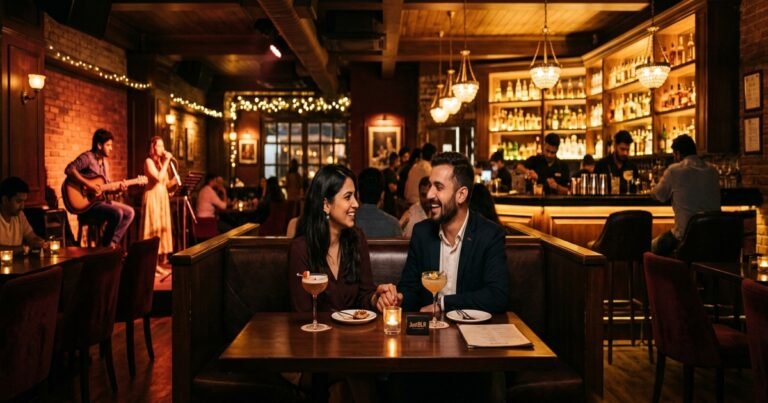
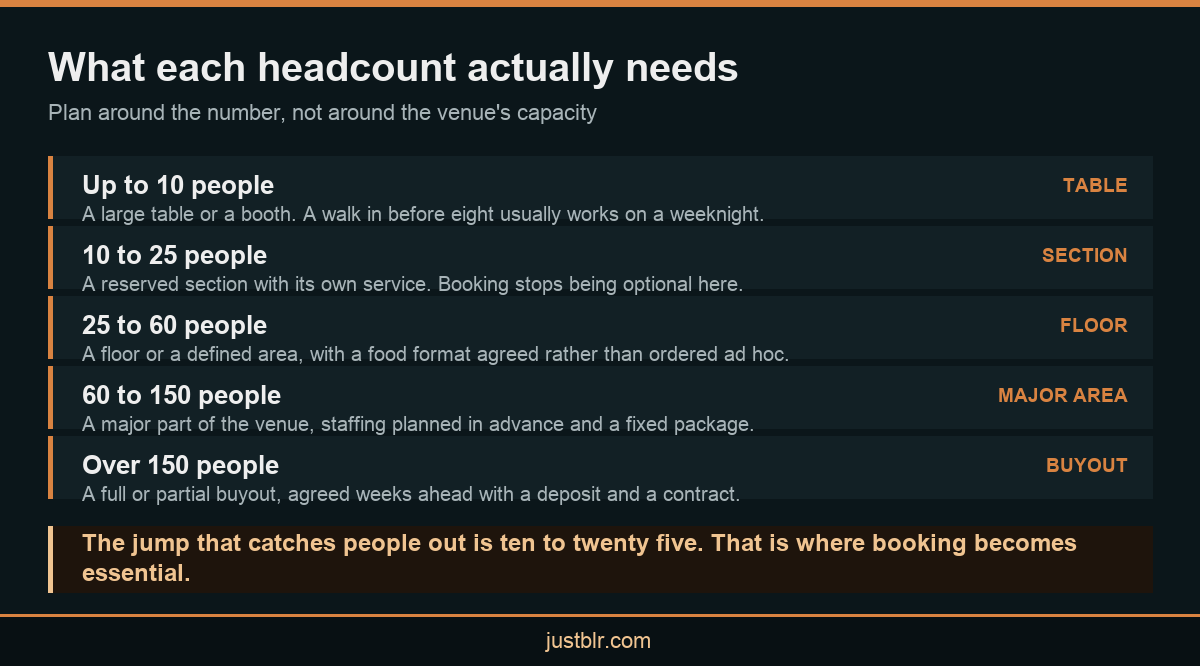
Up to about ten people, a large table or a booth is enough and a walk in before eight will often work, particularly midweek. The group is small enough to move, small enough to order individually and small enough to be absorbed by a room without any planning.
Between ten and twenty five, everything changes. This is the jump that catches most organisers out. A group that size cannot improvise somewhere to stand together on a busy night, and a reserved section becomes the difference between an evening and three hours of standing.
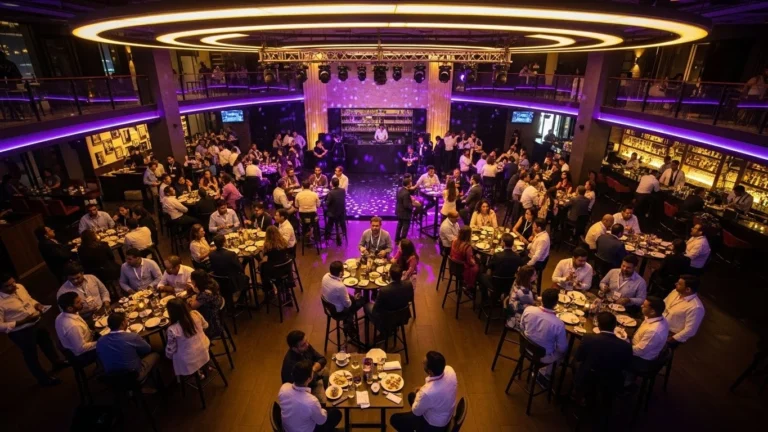
From twenty five to sixty, the group needs a defined area and a food format agreed in advance. Letting forty people order individually produces a kitchen queue that ruins the first two hours, and no venue can solve that on the night.
Between sixty and a hundred and fifty, you are taking a significant part of the venue, which means staffing has to be planned ahead and a package format is almost always better value than assembling the same evening from a menu.
Above a hundred and fifty, it becomes a buyout conversation, agreed weeks ahead with a deposit and a written agreement. At that point it is an event rather than a night out, and it should be planned like one.
The guide to party places and clubs in Bangalore for groups covers the same ladder from the organiser’s side, including budget approval, invoicing and the practical differences between a venue that hosts groups and one that merely accepts them. Group hosting is an operational capability rather than a feature of a room, and corporate entertainment at any scale lives or dies on whether the venue has actually done it before.
The six questions worth asking on the call
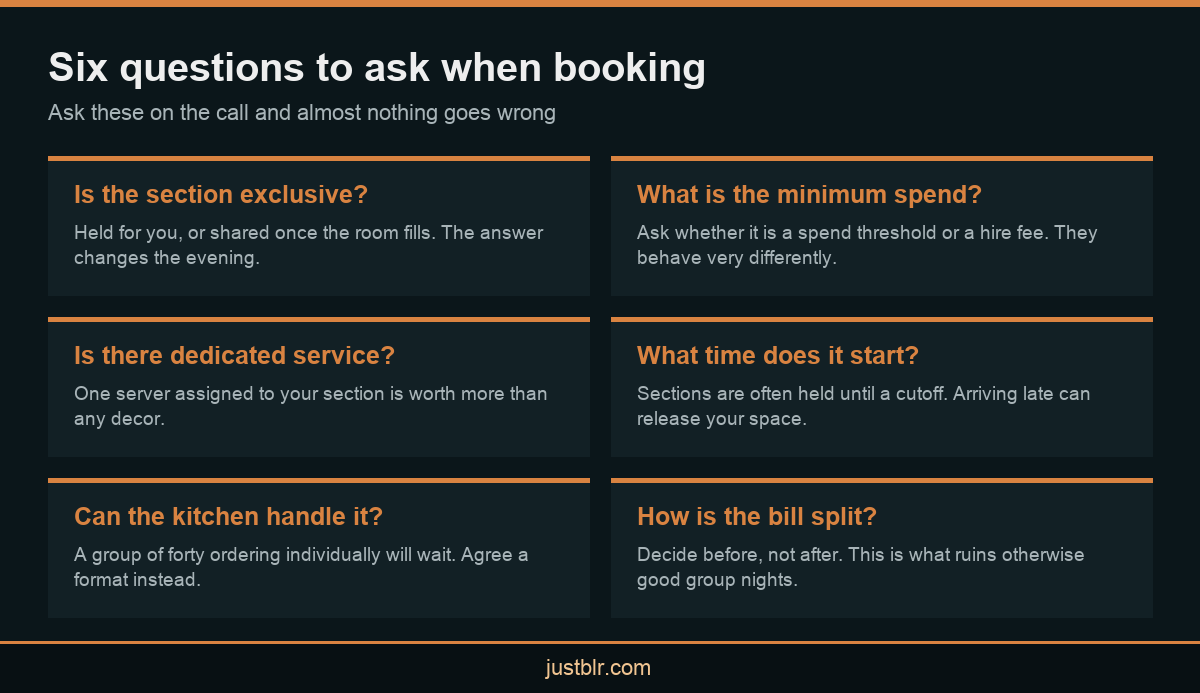
Ask whether the section is exclusive. Held for your group, or shared once the room fills, are two completely different products and both get described as a reserved area. The answer changes the evening more than any other single detail.
Ask what the minimum spend covers and whether it is a spend threshold or a hire fee. A threshold you were always going to reach costs nothing. A hire fee is a real cost, and the two get confused constantly on both sides of the conversation.
Ask whether service is dedicated. One server assigned to your section is worth more than the decor, the playlist and the view combined, because a group of twenty with no assigned server spends the evening walking to a bar.
Ask when the hold is released. Sections are frequently held until a cutoff time on busy nights, and a group arriving at half past ten for a section held until ten is a group that no longer has a section.
Ask whether the kitchen can handle the headcount. A group of forty ordering individually at nine will wait, and agreeing a format in advance is the only thing that fixes it. Venues will say yes to a format they cannot deliver if nobody asks specifically.
Finally, decide how the bill is split before the evening rather than after it. This is what ruins otherwise good group nights more than any venue failure, and it takes one sentence on the group message. The Just BLR package options show what a fixed format typically covers.
Choosing a venue that can actually take a group
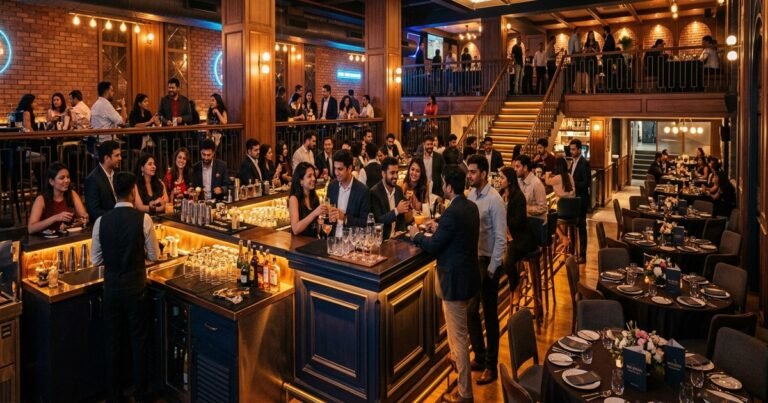
The first thing to look for is separation. A venue where dining, drinking and dancing happen in different areas can hold a group of twenty with three different plans, while a single room club has to make all twenty people want the same thing at the same time.
Multi floor venues are the strongest format for this reason. The people who want to sit and talk and the people who want a floor stay in the same building, which means nobody leaves early and nobody spends the night texting to find each other.
Menu breadth matters more than menu quality above about fifteen people. One vegetarian, one person avoiding spice and one who wants pasta will defeat a narrow list, and the negotiation that follows costs twenty minutes of an evening that is only four hours long.
Ask about capacity honestly rather than reading a number. A room licensed for three hundred is not comfortable for a group of fifty on a Saturday at eleven, because those fifty people need to be somewhere specific rather than distributed through a full room.
Weeknights transform the whole exercise. A group of thirty on a Wednesday gets better service, better pricing and a better room than the same group on a Friday, and midweek programming exists across the strip precisely because venues want that business.
Just BLR runs three floors in Deena Complex on Brigade Road with a capacity of around three hundred and fifty, which covers everything from a table for ten to a major area booking without the group having to move between venues at half past ten.
Keeping a group together once you are inside
Arrive together if you can. A section held for twenty that fills across ninety minutes looks empty for an hour, and venues managing a full room on a Saturday notice that faster than most organisers expect them to.
Agree a rally point inside the venue rather than relying on messages. Signal in a full room is unreliable, and a named table or a specific corner works considerably better than a general instruction to meet near the bar.
Somebody should keep a loose count through the peak hours. Not in a controlling way, but a group of twenty in a full room loses people easily between eleven and one, and a quick check every half hour prevents the phone calls that otherwise happen at the end of the night.
Eat early and eat together. It is the single most reliable thing that keeps a group in one place, and a group that ate at eight is still together at midnight far more often than one that grazed separately across the evening.
Agree the exit at ten. The window between half past midnight and quarter past one is when the whole strip leaves at once, and organising twenty people during it is genuinely unpleasant. The corporate parties page covers how larger bookings usually handle the end of an evening.
One person should hold the booking details and the venue contact number. It sounds obvious and it is the thing most often missing when a group of twenty arrives and nobody can remember which name the section is under. Two people knowing is better than one, in case somebody is running late.
Conclusion
The venues that work for groups are the ones that handle the booking properly rather than the ones with the biggest room. Work out what your headcount actually needs, ask the six questions on the call, choose a venue with separated areas, arrive together and agree the exit early. Do that and a group of twenty has the same easy evening a group of four does. Reserve a section at Just BLR.