Bar in MG Road: Menus, Pricing and Ordering
What you spend at a bar in MG Road has surprisingly little to do with which bar…
What you spend at a bar in MG Road has surprisingly little to do with which bar you chose. Drink count, spirit tier
and whether anybody ate account for most of the variation, and two groups at identical tables can leave with bills
that differ threefold. This guide covers how bar pricing actually works on the central strip, how to read a drinks
menu properly, what to order at which point in the evening, and where the money genuinely goes.
Key Takeaways
-
Drink count and spirit tier drive the bill far more than the venue does. Two groups at identical tables can differ
by a factor of three. -
Draught is usually better value and fresher than the bottled equivalent, and it is the easiest saving available that
costs nothing in quality. - Cover charges, where they apply at all, are usually redeemable against the bill rather than being a pure entry fee.
How bar pricing actually works
Most bars price spirits in three tiers, and the difference between them is larger than the difference between venues.
A house pour, a call brand and a premium brand can span a considerable range within the same room and the same drink.
The practical consequence is that asking which tier a house pour uses is worth more than comparing two bars on price.
A bar with a good house tier is cheaper for an entire evening than one whose base level is a brand you would not
choose.
Measure size is the second variable and it is rarely displayed prominently. A larger measure at a slightly higher
price is often better value, and a smaller one at a lower price is not the saving it appears to be when you are
ordering four.
Draught beer is generally better value and fresher than the
bottled equivalent, which makes it the easiest saving available on any bar menu. It is also the format that suits long
sessions and large groups best.
Cocktails sit at the top of the pricing structure because they take time, ingredients and attention. That is
reasonable, and it means a group ordering eight cocktails an hour is making a very different financial decision from
one ordering eight beers across the same four hours.
Cover charges, where they apply, are usually redeemable against food and drink rather than being a pure entry fee. Ask
before treating the figure as an additional cost, because at most venues on this strip it simply is not one at all.
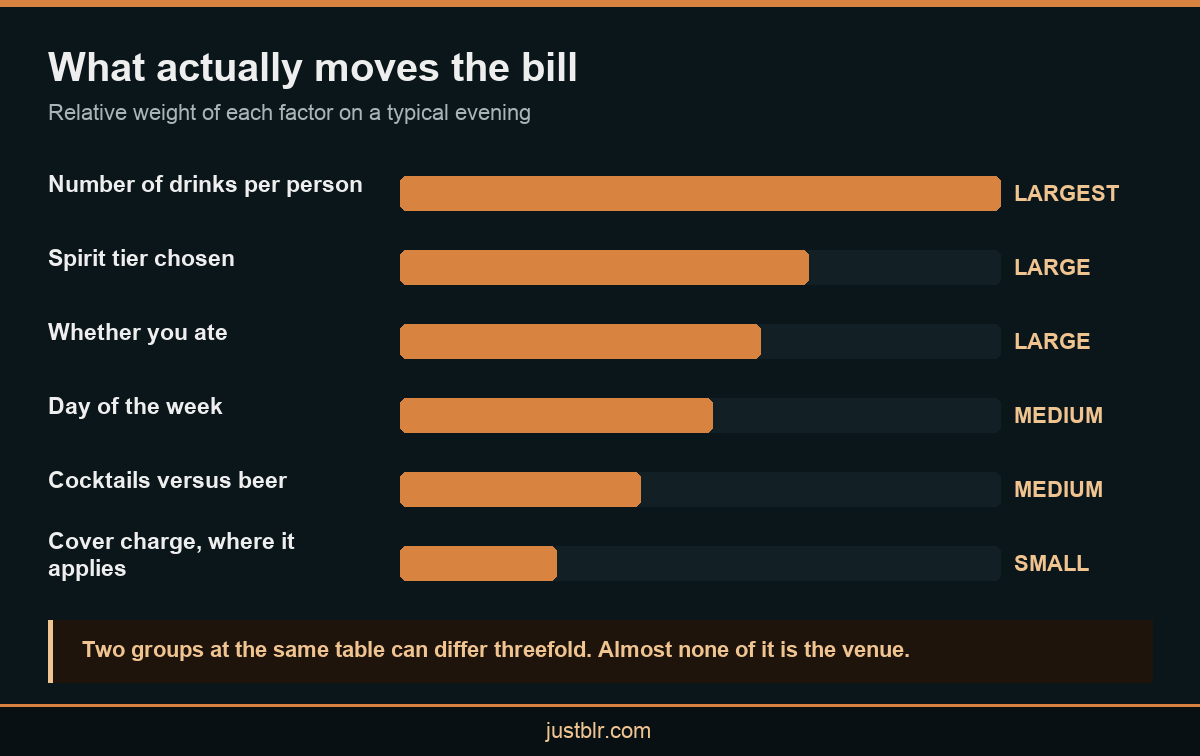
What actually moves an evening’s bill
Drink count is the largest factor by a wide margin, and it is almost entirely a function of pace rather than intent.
Nobody decides to have seven drinks. They have four hours, an empty stomach and a fast bar, and seven is the
arithmetic result of those three things rather than a choice anybody made.
Whether the group ate is the second and it works through the first. A group that ate properly drinks more slowly,
stays longer and leaves having spent less per hour than one that drank on an empty stomach and left after two hours
feeling the evening was expensive.
Day of the week is the third and the most underused. Monday to Wednesday is materially cheaper across the strip, not
because every price changes but because cover charges disappear, midweek offers appear and nobody is buying a table
simply to guarantee themselves somewhere to sit for the evening.
Spirit tier is the fourth and the easiest to control. Sticking to a good house tier across an evening produces a
noticeably different bill from mixing tiers without thinking about it, and in a group nobody notices the difference in
the glass once a mixer is involved at all.
The venue is a long way down this list, which is the part people find surprising. Prices vary less between rooms on
the same strip than they do between a Tuesday and a Saturday in one of them, which is the opposite of what most people
assume before they start comparing venues.
The last item everybody forgets is the ride home. The
Bangalore night pubs guide covers
the surge window between half past midnight and quarter past one, which regularly costs more than a round did.
Reading a drinks menu properly
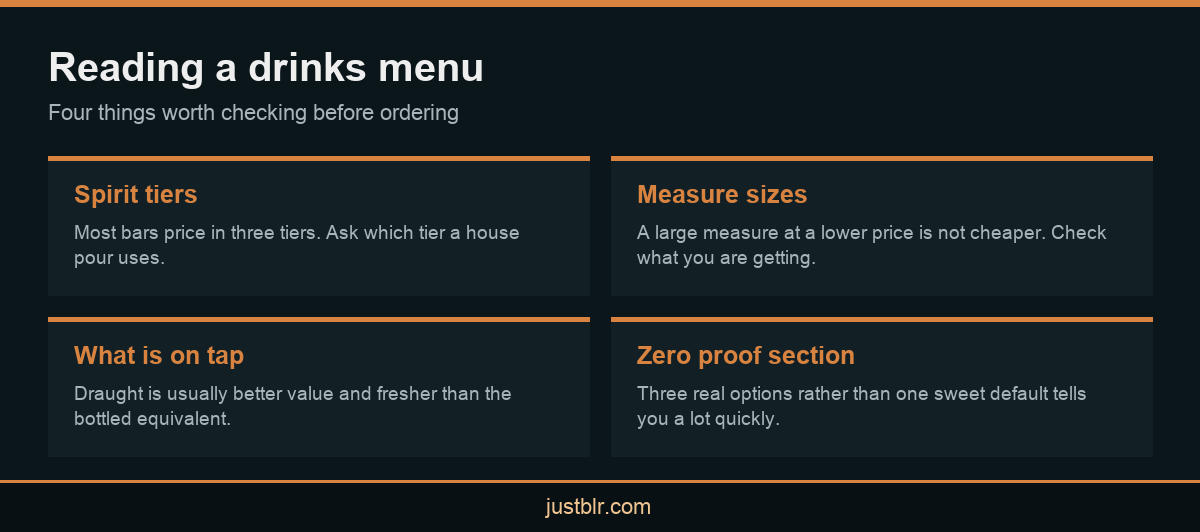
Start with the tier structure rather than the individual prices. Knowing what sits at house, call and premium level
tells you more about an evening’s cost than any single line on the menu, and it takes one question to a server.
Check what is on draught. Draught is fresher, usually better value and faster to serve than bottled, which matters
when a bar is busy and a group of eight is ordering. It is also the section most likely to include something brewed
locally rather than shipped in.
Judge the cocktail list by its length rather than its range. A short list means everything on it gets made regularly
and the person making it knows the build, while a very long one usually means half of it is being looked up.
Look at the zero proof section properly. Three genuine options rather than one sweet default tells you the bar has
thought about the person in every group of eight who is not drinking, and it is a reliable proxy for general attention
to detail across the whole operation.
Look at the food section too, even at a bar. A room with real
bar bites rather than a token list is a room where people eat, and
rooms where people eat are better rooms to spend four hours in.
Finally, look for anything unusual. A bar that carries one or two things nobody else on the strip has is a bar where
somebody is paying attention, and that attention usually shows up across the rest of the operation as well, from the
ice in the glass to how quickly a new table gets acknowledged on a busy night.
What to order, and when
Order the complicated things before ten. Bar attention is at its best in the middle of the evening, and a cocktail
made properly at half past nine is a genuinely different drink from the same one made quickly at midnight with a queue
behind you.
Switch to simple builds and long drinks as the room fills. That is not a compromise, it is a better outcome for
everybody, because a simple drink made well beats a complicated one made in a hurry every single time.
Order two at once during the peak. A queue at eleven costs twenty minutes and a second drink ordered alongside the
first costs nothing extra, which makes it practical rather than excessive.
Eat something, even at a bar. It changes the pace, extends the evening and lowers the cost per hour more reliably than
any decision about what to drink, and it is the single most useful habit anybody can bring to a night out.
Tell the bartender what you like rather than reading the whole list. Two sentences about whether you prefer things
bitter, sour or spirit forward gets a better result than ten minutes with a menu, in any bar in the city.
Just BLR runs a full bar alongside a multi cuisine kitchen across three floors in Deena Complex on Brigade Road, and
the drinks menu is published in full so a group can decide before
arriving rather than at a busy counter with several people waiting behind them.
Conclusion
What you spend on this strip is decided by pace, spirit tier and whether anybody ate, far more than by which door you
walked through. Ask about the tier structure, check what is on draught, order the complicated drinks before ten and
eat something. Go midweek if the bill matters and plan the ride home before the surge.
Reserve a table at Just BLR.