Best Pubs in Bangalore: How to Choose Yours
Everybody has a list of the best pubs in Bangalore and almost none of those lists agree,…
Everybody has a list of the best pubs in Bangalore and almost none of those lists agree, because they are ranking rooms rather than matching them. A venue that is perfect for four people on a Tuesday is entirely the wrong answer for twenty on a Saturday. This guide takes the opposite approach. It sets out the criteria that actually decide whether an evening works, applies them by occasion, by area and by budget, and covers the booking practicalities that ruin more nights than any bad venue ever has.
Key Takeaways
- Judge a room on its kitchen, its sound design, its table spacing and its service, not on where it appears in somebody else’s ranking of the city.
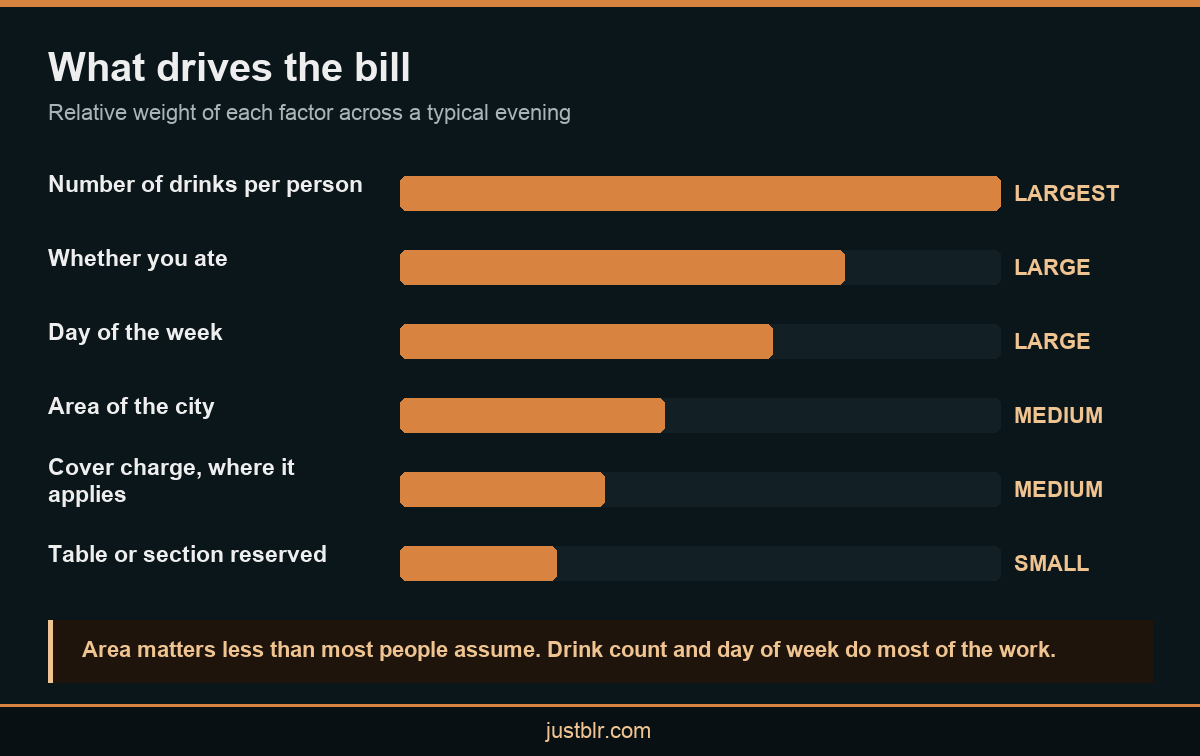
- Area matters less than most people assume. Bengaluru drink prices vary far less across neighbourhoods than drink count and day of week vary within them.
- Above six people a booking is not optional on a weekend, and above twelve a reserved section is the difference between an evening and three hours of standing.
- Weeknights change a room more than any venue decision can. The same space holds sixty people on Tuesday and three hundred on Saturday.
How to judge a pub before you commit an evening to it
Ranked lists are entertaining and close to useless, because they compare rooms without knowing anything about your group, your night or what you actually want out of the next four hours. A far better approach is a short set of criteria you can check yourself, from the doorway, in under a minute.
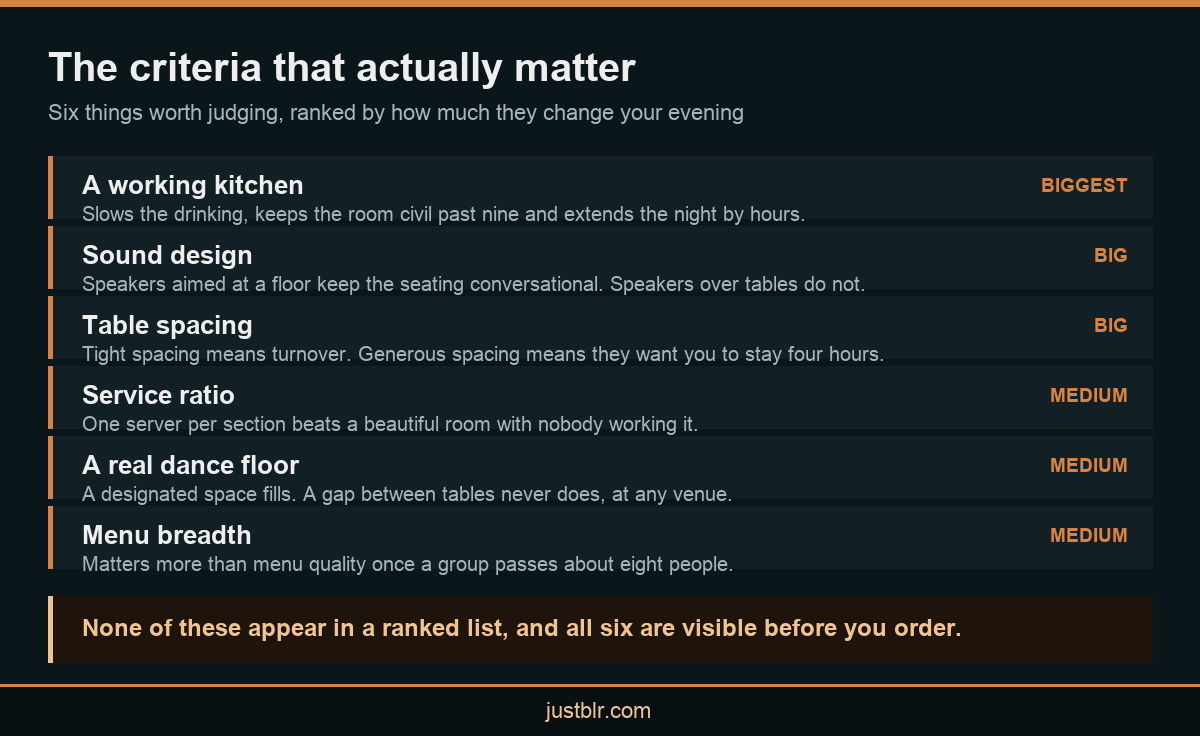
A working kitchen is the single biggest signal. It slows the pace of drinking, gives everybody a reason to stay seated past nine, and keeps the volume civil for at least an hour longer than a drinks only bar manages. Rooms without one get loud earlier and empty faster, almost without exception.
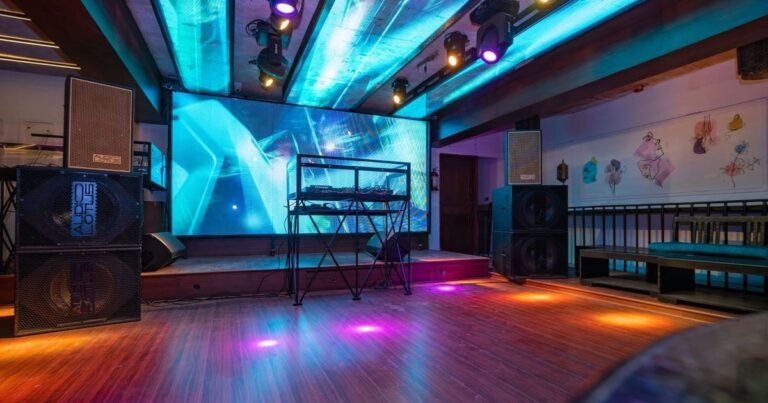
Sound design comes second and is the one nobody checks. Look at where the speakers point. Aimed at a dance floor, the seating stays conversational even at peak. Mounted over the tables, the room is designed to become loud and it will, usually somewhere between ten and eleven.
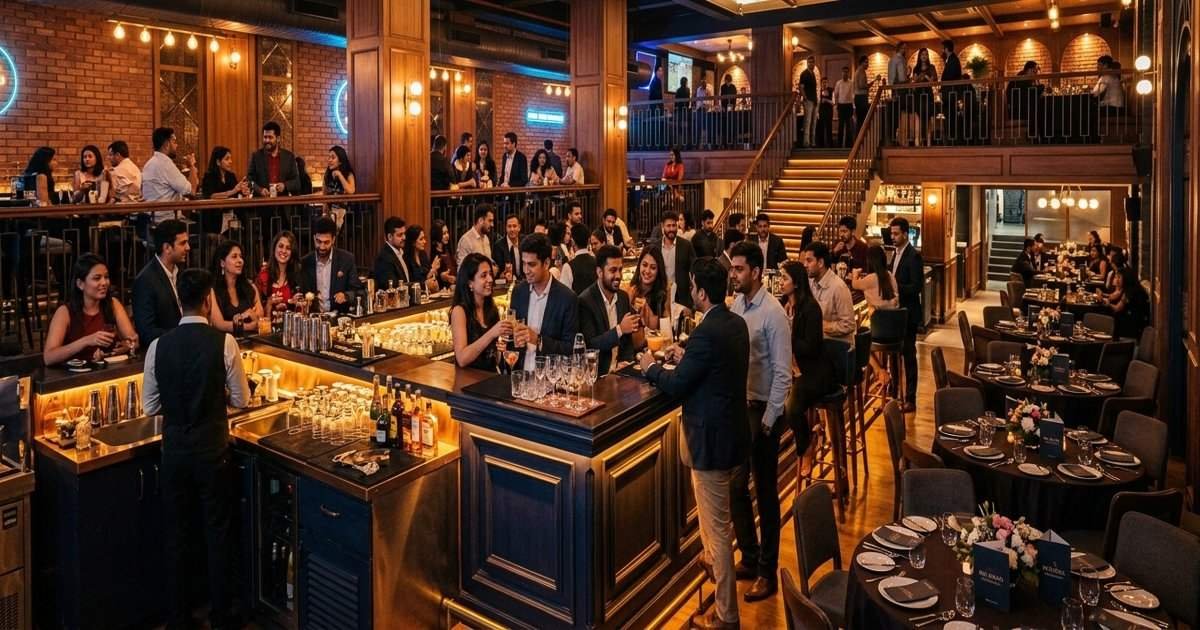
Table spacing tells you what the venue wants from you. Tight spacing means fast turnover and a room that expects you to leave once you have eaten. Generous spacing is a venue happy for you to stay four hours, which is what you want if the plan is an evening rather than a drink.
Service ratio is invisible until it fails. A beautiful room with two people working four sections will frustrate a group of ten within twenty minutes. Watch how long it takes for anybody to acknowledge a table that has just sat down, and judge accordingly.
Finally, if dancing might happen, look for a designated floor rather than a gap between two rows of tables. A real floor fills by eleven. A gap never fills at all, because nobody wants to be the first person dancing beside somebody else’s dinner.
Menu breadth is the last criterion and it only matters once a group passes about eight people. One vegetarian, one person avoiding spice and one who wants pasta will defeat a narrow list instantly, and the negotiation that follows costs twenty minutes nobody enjoys.
The signals that mislead
Decor tells you almost nothing about whether an evening will work. Neither does the length of the cocktail list, nor how busy the room looks from outside at nine, because busy at nine and busy at eleven are produced by completely different things. Judge the structural features instead, because those are the ones that stay true all night rather than for the first hour.
What a good pub does when it is quiet
The real test of a room is a Tuesday. A venue that is pleasant with sixty people in it is a genuinely good venue, because the atmosphere is coming from the space and the staff rather than from the crowd. A room that only works when it is full is a room that needs three hundred strangers to do its job for it.
Choosing by occasion, because the reason changes the room
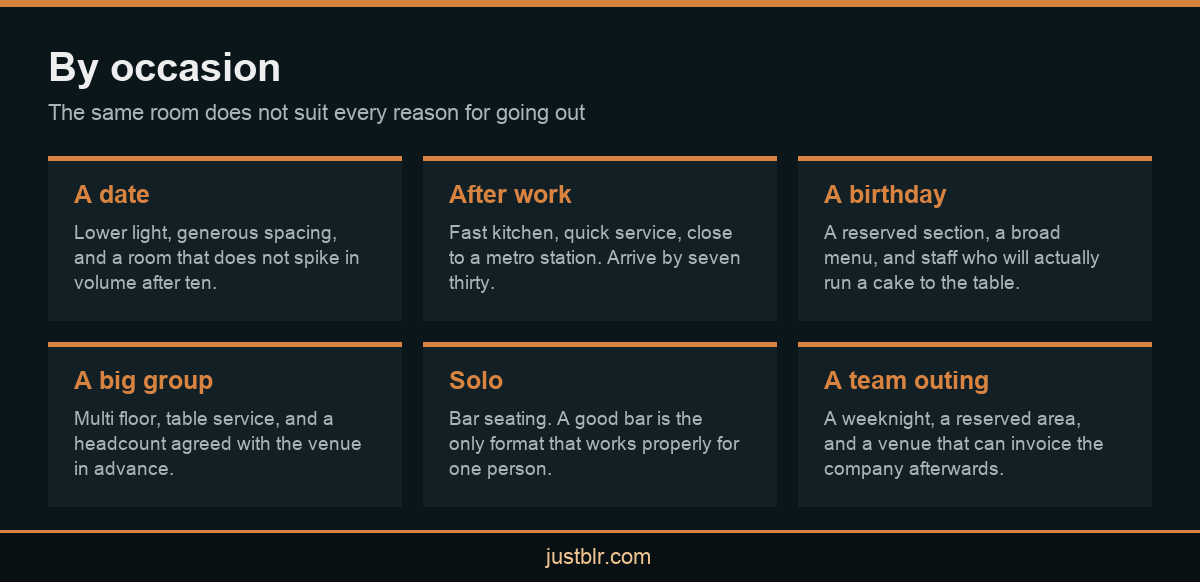
The most common cause of a disappointing evening is a mismatch between the occasion and the format. Nobody chose a bad venue. They chose a venue that was excellent at something other than the thing they wanted to do that particular night.
For a date, ambience decides everything, and ambience means lighting, spacing, volume and whether the staff leave you alone. The important question is what the room does after ten, because plenty of places are lovely at half past eight and unusable two hours later.
For after work drinks, speed matters more than anything. A fast kitchen, quick service and a short walk from a metro station beat any amount of atmosphere when six people have ninety minutes and have not eaten since lunchtime. Arrive by half past seven and the evening works.
For a birthday, the deciding factor is whether the venue will actually do the small things. A reserved section, a broad menu that suits everybody invited, and staff willing to run a cake to the table at the right moment matter more than the room itself does.
For a large group, multi floor venues win because a party of twenty rarely wants one thing. Some want to eat, some want to dance and some want somewhere quiet to sit, and a building with three levels serves all three without anybody leaving or splitting the bill.
For a solo visit, bar seating is the only format that genuinely works. A table for one in a room full of groups is uncomfortable in a way a bar seat never is, because a good bar gives you something to watch and somebody to talk to if you feel like it.
For a team outing the deciding factors are administrative rather than atmospheric. A weeknight, a reserved area and a venue that can raise a proper invoice afterwards matter more than the room, because the person organising it has to justify the spend to somebody who was not there.
Choosing by area across the city
Central Bengaluru around MG Road and Brigade Road is the densest cluster in the city, and the one with the best transport. Everything sits within a short walk of everything else, which means a poor first choice costs five minutes rather than a cab fare and an argument.
Indiranagar is spread out and leaning newer, with a strong craft beer and cocktail scene. It rewards knowing where you are going, because wandering between venues involves genuine walking rather than crossing a road, and parking is harder than the area first suggests.
Koramangala skews younger and more casual, with a heavy student and early career crowd. It is excellent value and reliably lively, and it is less suited to an evening where somebody needs to be impressed or where the group spans two generations.
Church Street sits just off the central strip and is the part most people miss. It is walkable from MG Road, quieter on foot than Brigade Road, and carries a mix of dining and drinking that suits a group that has not quite decided which of the two it wants.
The honest conclusion on area is that it matters less than people assume. Drink prices vary far less between neighbourhoods than they vary between a Tuesday and a Saturday in the same room, and transport is a bigger practical factor than atmosphere.
For the central strip specifically, the MG Road Bangalore nightlife guide covers the geography, the timings and the entry rules at street level rather than treating the whole city as one undifferentiated nightlife market.
One area factor that does matter is the journey home. A venue on a metro line is easy to reach and still needs a cab at the end of the night, while a venue nobody can walk to from anywhere adds a fare at both ends and quietly changes what the evening costs.
Choosing by what you actually want to drink
Craft beer is well served in Bengaluru and it is genuinely the city’s strongest category. Microbreweries produce their own, which means freshness and range that bottled lists cannot match, and it suits long sessions because the pace is naturally slower.
Cocktails are the fastest growing category and the most variable. A good programme means fresh juice, proper ice, a bartender who can make classics as well as signatures, and a list short enough that everything on it is made regularly rather than looked up.
Spirits led drinking is the quietest and often the best value. A room with a decent back bar, bar seating and somebody who knows what is on the shelf delivers a better two hours than a crowded floor, particularly on a weeknight when the bartender has time to talk.
Zero proof deserves more attention than it usually gets. Any group of eight now contains at least one person not drinking, and a venue with three real options rather than one sweet mocktail makes a measurable difference to whether that person enjoys the evening.
Food and drink together is the format that suits most groups best in practice. A multi cuisine kitchen running alongside a full bar means nobody has to choose between eating properly and staying out, which is the choice that ends most evenings earlier than anybody intended.
The best restobar in MG Road guide covers how the two sides of that format work together, and what separates a venue with a kitchen from a venue that serves food.
Whatever the category, judge the list by how short it is rather than how long. A tight list means everything on it gets made regularly and the bartender knows it by heart. A very long list usually means half of it is looked up while you wait.
What an evening actually costs
Two groups at identical tables can leave with bills that differ by a factor of three, and the difference is almost entirely drink count and whether anybody ordered food. The name above the door is close to irrelevant to the final number in a way most people find surprising.
Food is the cheapest way to extend a night. A group that eats properly early drinks more slowly, stays considerably longer and spends less per hour than a group that drinks on an empty stomach and leaves after two hours feeling that the evening was expensive.
Day of the week is the second biggest lever and the most underused. Monday to Wednesday is materially cheaper across the whole city, not because every price changes but because cover charges disappear, midweek offers appear and the pressure to buy a table goes away entirely.
Cover charges, where they apply at all, are usually redeemable against the bill rather than being a pure entry fee. That makes them closer to a deposit than a cost, and it means the figure quoted at the door overstates what you actually spend by the whole amount.
The item everybody forgets is the ride home. A cab during the late night surge can cost several times what the same trip cost at nine in the evening, and it is the one line in the night that never appears on any venue’s menu or in any review.
The practical conclusion is that the levers worth pulling are behavioural rather than geographic. Eat, go midweek where you can, and plan the exit. Those three habits save more than any amount of comparing venues on price ever will.
It is also worth being honest with the group about the number before anybody orders. Evenings go wrong far more often over an unexpected split than over a genuinely high bill, and a thirty second conversation at the start removes an awkward one at the end.
Timings, entry rules and booking practicalities
Bengaluru venues generally stop serving around one, which compresses an evening more than visitors expect. The genuinely useful window is roughly the four hours between eight and midnight, and every planning decision should be made against that rather than against opening hours.
Original photo identification is expected at most doors after a certain hour, and an Aadhaar card, a driving licence or a passport all clear without discussion. Everybody in the group needs their own rather than one person carrying proof for four.
Dress codes are relaxed by international standards but genuinely enforced at the busier rooms. Smart casual clears every door in the city. Shorts and open footwear are the two items refused most often, and refusals climb sharply after ten when rooms no longer need the business.
Booking is not optional above six people on a weekend. Most venues will hold a section with a phone call and an approximate headcount, usually without a deposit, which makes not calling a strange decision rather than a relaxed one.
Give an honest headcount rather than an optimistic one. A section held for twenty that receives twelve feels empty all evening, and one held for twelve that receives twenty means somebody spends three hours standing. Venues plan around the number you actually give them.
For groups that need invoicing, a private area or a fixed format, the corporate party places in Bangalore guide covers how that side of a booking works and what to ask before committing to a venue.
One last practicality is the kitchen closing time, which is almost never the same as the venue closing time. A room where food stops at ten behaves very differently after that hour from one where the pass stays open until close, and a late arriving group notices immediately.
Weeknights versus weekends
The same room delivers two completely different evenings depending on the night. Rooms holding three hundred people on Saturday hold around sixty on Tuesday, service is faster, the music sits under conversation and a table is a phone call rather than a negotiation. For anything where talking matters, midweek beats any venue choice you could make on a weekend.
When to arrive
Before eight, you choose your table. After ten, the room chooses for you and the difference in quality is usually substantial. Early arrival also fixes the parking problem, gets you served before the kitchen slows down at nine, and means the group is settled by the time the venue reaches capacity rather than still standing near the door negotiating.
Booking a section for a group
Above twelve people, a reserved section is the difference between an evening and three hours of standing. Say what the occasion is when you call, because a birthday, a team outing and a farewell all need different seating even at the same headcount, and floor staff will arrange the room accordingly if somebody actually tells them.
Where Just BLR fits and who it suits
Just BLR sits in Deena Complex on Brigade Road, opposite McDonald’s, at the busiest pedestrian point of central Bengaluru. Three floors, a capacity of around three hundred and fifty, and a full kitchen running alongside the bar and the floor rather than closing early.
The multi floor layout is the practical reason it suits mixed groups. Dining, drinking and dancing happen on separate levels of one building, so a group of twenty arriving with three different ideas about the evening does not have to split up or compromise on a single room.
The kitchen runs Indian, Italian, Continental, Northeast and Asian, which is unusual for a venue that is also a genuine late night room. The main course menu is published in full, so a group can agree the order before anybody leaves the office.
The weekly line up is fixed rather than occasional. Karaoke on Wednesday, live acts on Thursday and comedy on Friday give the midweek a reason that does not depend on a discount, and the events page carries the current schedule.
For groups there are four package tiers and a direct enquiry route, which covers birthdays, team outings and corporate evenings without needing a separate conversation about whether the venue can handle the headcount.
Who it suits: groups that have not fully decided, anybody who wants to eat properly and stay out afterwards, and people who would rather not spend the first hour of an evening walking between three rooms trying to reach a consensus.
Who it suits less well: anybody looking for a genuinely quiet room on a Saturday at eleven, which is not something this address can honestly offer, and anybody who wants an open air evening, since the format here is indoor across all three of the floors.
Putting the criteria to work
The method is simple enough to use every time. Start with the occasion, because it decides the format. Then pick the night, because the night changes the room more than the room changes itself. Then apply the six criteria at the door and commit.
Book if the group is above six, and give an honest headcount when you do. Arrive before eight if the table matters, and after ten only if the floor is the whole point of the evening rather than an optional extra somebody might want later.
Eat properly. It is the single most reliable predictor of whether a group has a good night rather than an expensive one, and it costs less than the drinks it displaces over the course of an evening.
Stop comparing after the second option. In a dense area the difference between your first and third choice is smaller than the difference between arriving at eight and arriving at ten, and the time spent deciding is time taken out of a night that ends at one regardless.
If the plan involves a dance floor at any point, the best night clubs in Bangalore guide covers what separates a floor that fills from one that never quite does, and why that is usually a layout question rather than a music question.
Finally, agree the exit at the start. A finishing time and a pickup point decided at nine saves a long argument and a forty minute wait at one in the morning, and it takes about thirty seconds of anybody’s attention.
Conclusion
The best pubs in Bangalore are not a fixed list, they are a match between a room and a reason for being out. Judge the kitchen, the sound, the spacing and the service. Choose the night before you choose the venue. Book above six people, eat before nine and plan the exit early. Do that consistently and the city stops being a ranking to argue about and becomes a straightforward set of good evenings. Reserve a table at Just BLR.