

DJ Pubs in Bangalore: Where the Music Matters
DJ pubs in Bangalore range from rooms with a genuine resident who reads a crowd to rooms…
DJ pubs in Bangalore range from rooms with a genuine resident who reads a crowd to rooms running a playlist somebody built at six in the evening, and from the pavement they look identical. The difference is audible within twenty minutes and it decides most of what your night feels like. This guide covers what a resident actually does, how to tell one from a shuffle, what to expect on each night of the week, and how to time an evening around a set rather than around opening hours.
Key Takeaways
- A resident DJ reads the room, builds and releases energy, and owns the transitions. A playlist does none of those things and it is audible quickly.
- Midweek is when you hear a set properly, because the room is small enough that the programming rather than the crowd is doing the work.
- Sets run to a schedule rather than to opening hours, so arriving an hour late means walking into a room that already found its energy without you.
What a resident actually does
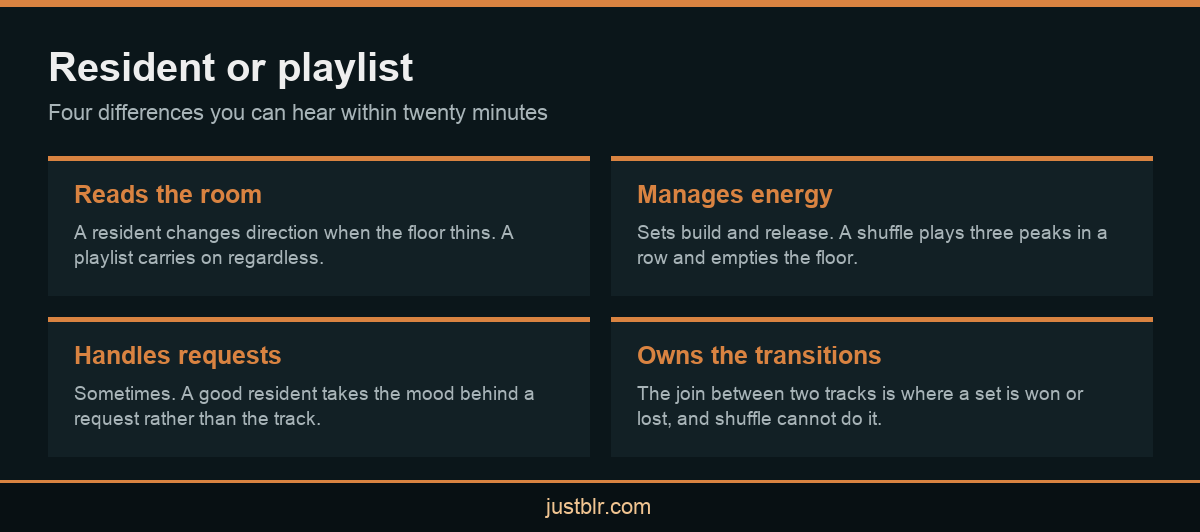
The core of the job is reading the room. A resident watches the floor and changes direction when it thins, pulls back when the energy needs a rest, and pushes when the room is ready. A playlist decided at six in the evening cannot do any of that.
Energy management is the visible part of it. A good set builds and releases in cycles rather than running at maximum for three hours, and that shape is why a well programmed floor stays full while a louder one empties by half past midnight.
Transitions are where a set is genuinely won or lost. The join between two tracks either keeps the floor moving or gives everybody a two second reason to head for the bar, and a shuffle has no way of controlling that at all.
Requests are handled differently by good residents than most people expect. The useful ones take the mood behind a request rather than the specific track, which is why asking for something and getting something else that works is a sign of competence rather than of being ignored.
Programming across a week is the invisible part. A resident who plays four nights knows which crowd arrives on which night and builds different sets for each, and that consistency is what turns a room into somewhere people return to.
None of this is about equipment or genre. The energy in a Bangalore nightclub piece covers why the same music produces completely different nights in different rooms, and the answer is almost always about programming rather than about the tracks themselves.
How to tell a resident from a shuffle
Watch the floor rather than the booth. If the floor thins and the music does not respond within two or three tracks, nobody is reading the room, and the rest of the evening will follow the same pattern regardless of how good any individual track is.
Listen to the joins. Clean transitions that keep momentum are the clearest single indicator. Hard stops between tracks, or a two second silence, means the room is running a queue rather than a set and the floor will empty in stages.
Look for shape across half an hour. A set that stays at exactly one intensity for thirty minutes is a shuffle. One that builds, peaks and eases off is somebody working, and the difference becomes obvious once you are listening for it.
Check whether anybody is actually at the booth. It sounds obvious, but plenty of rooms have equipment as decoration and run electronic or chart playlists through it, which is fine as long as you know before deciding this is where the night happens.
Genre consistency is a weaker signal than people think. A resident may move between commercial, Bollywood and house across one night, and doing that well is harder than staying in a single lane rather than a sign of confusion.
The whole assessment takes about twenty minutes, which is roughly one drink. That is why arriving at ten rather than at midnight matters: it gives you time to decide whether to stay before the night’s useful hours have already been spent. One drink is a cheap price for knowing whether to stay or move on.
What to expect on each night of the week
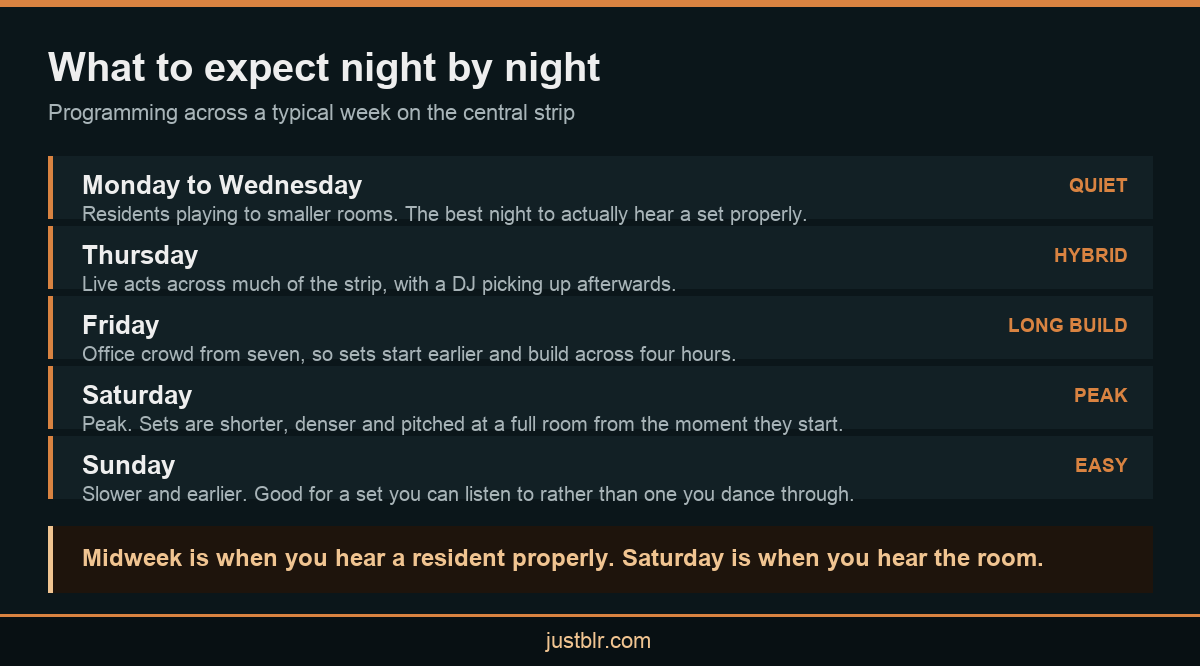
Midweek is when you actually hear a set. Rooms are smaller, residents have more freedom, and the programming rather than the crowd is doing the work. For anybody who cares about the music specifically, Tuesday and Wednesday are better than Saturday.
Thursday across much of the central strip belongs to live acts, with a DJ picking up afterwards. That hybrid format has its own timing, because the set only starts once the band finishes and the room resets.
Friday is the long build. The office crowd arrives from seven, so sets start earlier and develop across four hours rather than three, which produces a gentler and often more enjoyable arc than a Saturday manages.
Saturday is peak and it is a different job. Sets are shorter, denser and pitched at a full room from the first track, because the crowd arrives already expecting the peak rather than being walked up to it.
Sunday is slower and earlier, and it is the most underrated night for anybody who wants to listen rather than dance. Rooms are relaxed, sets are less driven, and the whole thing finishes at a civilised hour.
The Friday versus Saturday comparison covers how those two nights differ in more detail, including why the arrival pattern changes everything about how a set has to be programmed. Programming for a room that arrives all at once is a different craft from programming for one that fills across four hours.
Timing a night around a set
Sets run to a schedule rather than to opening hours, and that is the single most useful thing to know. Arriving an hour after a set started means walking into a room that already found its energy without you, and catching up is harder than it sounds.
Floors do not fill before ten in this city, so a set before that is playing to a mostly empty room. That is genuinely worth hearing if the music is the point, and worth skipping entirely if dancing is.
The peak sits between eleven and midnight and last orders arrive at around one. Arriving at ten gets you the build, the peak and the finish. Arriving at half past eleven gets you the last third of somebody else’s evening.
Eat first. A floor is a poor place to be hungry, and a group that has eaten stays considerably longer and enjoys the peak rather than spending it trying to work out where food might come from at half past eleven.
Check what is on before deciding. The Just BLR events page lists the current weekly programming, and two minutes spent reading it prevents the fairly common experience of arriving for a DJ night on the one evening the room is doing something else.
Just BLR sits in Deena Complex on Brigade Road with three floors, so the set and the seating are on different levels. That matters for a group where half the people want to hear the music properly and half want to be able to hold a conversation without shouting over the peak of a set.
Conclusion
The DJ pubs in Bangalore worth returning to are the ones with a resident rather than a playlist, and the difference is audible within about twenty minutes. Watch the floor, listen to the transitions, look for shape across half an hour, and go midweek if the music itself is the point. Arrive at ten, eat first, and check the programming before you commit the night. Reserve a table at Just BLR.